


















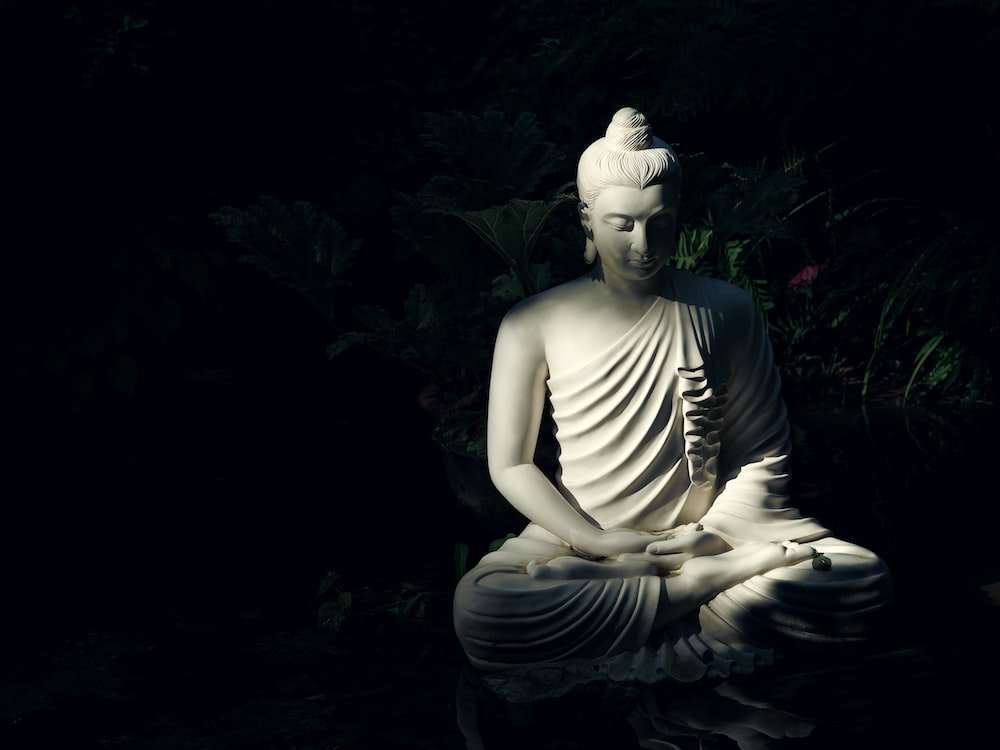
- Who was Buddha ? What is Buddhism and is it a religion or philosophy ?
- These questions might trigger in your mind whenever you hear the word Buddhism. Right ?
This article will surely clear your doubts about Buddhism , so stay till the end

WHAT IS BUDDHISM ?
Buddhism is one of the largest religions in the world. It is quite different from other world religions. For example, almost all religions have a God who is a sacred spirit. Buddhism has Buddha, who was a man reached nirvana. There are several “types” of Buddhism that are now considered different religions: Hinduism, Buddhism and Jainism. However, all these religions are based on one teaching and have common principles.
WHO FOUND BUDDHISM ?
The founder of Buddhism in this world was Buddha Shakyamuni who lived and taught in India around 2,600 years ago. Since then millions of people around the world have followed the pure spiritual path he revealed.
Buddha explained that all our problems and suffering arise from confused and negative states of mind, and all our happiness and good fortune arise from peaceful and positive states of mind.
Buddhism itself started sometime in the fifth century BCE. We now think that the Buddha, who founded the religion, died sometime toward the year 400 BCE. As Buddhism developed, it spread beyond India. A number of different schools emerged.
Buddhism arose in Ancient India, in and around the ancient Kingdom of Magadha, and is based on the teachings of the ascetic Siddhārtha Gautama. The religion evolved as it spread from the northeastern region of the Indian subcontinent throughout Central, East, and Southeast Asia.

WHAT WE LEARN FROM BUDDHISM ?
Buddhism is a man oriented, human centric, and earthbound religion, making it unique and different from other beliefs. This is an intricate subject and we need to have a deeper understanding for a better appreciation.
The Buddha is neither a god nor divine being. The Buddha is a human being, not an ordinary human being, but an extraordinary human being with extraordinary qualities and abilities.
Buddhism is a “Do It Yourself” kind of religion, where we must walk the path ourselves, not through mere beliefs. The Buddha teaches the Dhamma for us to cultivate ourselves, gives us the Dhamma as a torchlight to find our way and as the path to enlightenment, but we must walk this path ourselves. The Dhamma is likened to a roadmap that shows us how to get from Point A to B, but we must walk there ourselves, no one is going to carry us there.
In Buddhist practice, three things are essential: understanding, practice, and realisation. Understanding and practice must go hand in hand in order to realise Nibbana. This is achieved by following the Noble Eightfold Path to develop our ethical, spiritual, and intellectual qualities. So Buddhism is for people who are energetic and striving, who are investigative, who ask questions and analyse, and who are ready to take the challenge to test the teachings. Hundreds and thousands of human beings have understood the teachings of the Buddha, practised, and achieved enlightenment – this path is also open to us.
WHAT PEOPLE THINK ABOUT BUDDHISM ?
In the article by Tenzin Gyatso “Many Faiths, One Truth”, author discusses this question comparing the basic principles of Buddhism with basic principles of other religions. The author claims that there is not the best religion, all world religions teach people the same basic virtues but interpret them in different ways. Thus, it can be summarized that Buddhism is related to other religions of the world in spite of all its peculiarities, consequently, all “faiths” share “one truth” that is universal for all people.
According to Bailey and Fisher, “traditional cultures and religions naturally assumed their own points of view…Every culture saw itself as the center of the universe.” (2). However, the truth is that the world’s nations seek to uniting. And the same thing can be said about religion. Moreover, a proper analysis of different religions proves that the standpoints of all these religions are common.
For example, Buddha teaches to lead a pious life and live in piece with nature and people around. In addition, one of the core ideas of Buddhism is the theory of emptiness, which means that all things around are out of importance and the aim of everyone is to reach “nirvana”. The same assumption (but in different words) can be said about a core idea of Christianity: one should lead a right life in order to go to Heavens after the death.
Buddhism contains everything, Rinpoche repeats. He explains that philosophically, the Middle Way view is beyond all extremes. There is no existence and no non-existence. To be a genuine Buddhist practitioner means to relinquish all philosophical views. If one has a view of emptiness, then one does deity and pure land practices and makes offerings. Doing all these practices without seeing any contradictions is the sign of a true practitioner. But if we become picky and treat all the teachings as separate, we will miss out. Think of a giant jigsaw puzzle with missing pieces.
What is Buddhism? Should we consider it a religion? Maybe it is a philosophy? Or a “way of life”? Many people ask this question and sometimes people get uncomfortable when they see statues, flowers, candles, and incense. In this advice session with students, Phakchok Rinpoche explains that Buddhism encompasses a great deal. “Buddhism is everything!” he says. We can say Buddhism is a way of life and/or a way of thinking. Buddhism is about good behavior and empowering oneself with dignity. We can also describe it as a medicine to calm the mind. And, yes, Buddhism is also a philosophy.

“No matter how hard the past, you can always begin again.” ~ Budhha . With this quote of Buddha, I hope you understood about Buddhism and cleared your doubts .
Instagram- grace_content_